Arc Flash Risk Assessments in Wellington, FL
Need an arc flash risk assessment in Wellington, FL? Everything Arc Flash provides arc flash studies, hazard analysis, and NFPA 70E electrical safety support.

Maintaining electrical infrastructure across a large property requires more than a list of panels. Facility operators need to know how buildings are supplied, which equipment may expose workers to hazards, and whether electrical modifications have been reflected in the information used to plan maintenance.
Everything Arc Flash offers arc flash risk assessments in Wellington, FL, for commercial properties, healthcare facilities, educational institutions, municipal operations, and specialized or large institutional sites. We help property teams discuss hazard analysis in the context of the systems they manage and the maintenance activities those systems support.
Our Arc Flash Risk Assessment services can be scoped around a single building or the relevant distribution equipment across a larger property. Explain your operating arrangements and any known changes when you contact us. A well-defined project should make clear what is included, what records are needed, and how the findings will be communicated.
Map the Equipment Across Your Wellington Property
Large properties may distribute electricity through transformers, main switchboards, feeder circuits, motor control centers, and numerous local panels. Generators can introduce additional supply arrangements. The first organizational challenge is establishing how those assets relate to each other, particularly when buildings were constructed or modified at different times.
A useful inventory identifies equipment consistently without confusing building names, panel numbers, or department terminology. Wellington property managers can start by gathering existing schedules and drawings, noting where names differ from the equipment identifiers used by maintenance staff. Record uncertainties for review rather than guessing which feeder supplies a remote building.
- F01Commercial properties coordinating electrical work across occupied spaces
- F02Healthcare and educational facilities with diverse maintenance requirements
- F03Municipal operations overseeing several buildings or service departments
- F04Large institutional and specialized properties with distributed electrical assets
Plan a Scope That Matches the Maintenance Responsibilities
- 01
Identify who owns and operates each part of the electrical system. Some equipment may be controlled by a utility, a tenant, another institution, or a separate property team. Clear responsibility boundaries help determine the information and coordination required for a meaningful assessment, including assets that influence the analysis even when they are outside direct facility control.
- 02
Review previous assessments alongside the history of electrical alterations. Added panels, replaced transformers, revised motor loads, and generator modifications may affect existing assumptions. Field information may need to include protective-device details, conductor characteristics, and source data. Qualified personnel should determine safe access arrangements; collecting study inputs is not a reason for unqualified staff to approach exposed energized equipment.
- 03
Discuss scheduling early, especially where maintenance teams serve several buildings. The Arc Flash Risk Assessment Process provides a starting point for understanding project stages and information needs. Agree on how unresolved equipment information will be documented, who can answer operational questions, and what the final report will say about its limitations.
Hazard Findings, Labels, and Protective Measures
Arc flash analysis evaluates potential thermal exposure using the electrical characteristics and operating conditions included in the study. Incident energy calculations relate to a specified working distance. An arc flash boundary addresses a thermal exposure threshold, not the separate shock hazard associated with contact with or proximity to energized conductors.
Equipment labeling translates selected information into a reference at the point of use. To be useful, a label must match the equipment, remain legible, and reflect the applicable assessment. A newly installed panel should not inherit a nearby panel's values because the enclosures look similar or occupy the same room.
Protective measures depend on more than the label itself. The work activity, equipment condition, qualifications, and applicable procedures remain important. Arc Flash PPE Selection Guidance offers related information, while the assessment provides a technical basis that qualified personnel can consider when evaluating tasks and appropriate protection.

Use the Results to Plan Safer Maintenance Operations
Maintenance planning should consider the equipment supplying the work area, the sources that must be addressed, and the personnel authorized to establish safe conditions. On a multi-building site, a local shutdown may not describe every relevant supply. Assessment documentation can help clarify system relationships, but it does not replace field verification or the employer's procedures.
Coordinate work windows with affected departments and contractors. Explain the equipment involved, where relevant hazard information is stored, and who resolves discrepancies before work starts. Operational pressure to finish a project or keep a building occupied should not be treated as automatic authorization to perform energized electrical work.
Keep maintenance questions visible when reviewing the study's recommendations. Protective equipment must be maintained so its expected response remains credible. Arc Flash Safety-Related Electrical Maintenance Requirements connects these performance considerations with the wider safety program, supporting a more complete discussion than simply assigning new labels to old equipment.
Control Changes to Panels, Motors, Transformers, and Generators
Electrical modifications should have a documented assessment review step. Replacing a transformer, adding a motor control center, changing protective settings, or revising generator arrangements may change calculated conditions. The significance depends on the actual system; managers should request an evaluation rather than assume that a small physical alteration has a small analytical effect.
Collect closeout information while the project details are still available. Updated drawings, equipment ratings, settings, and operating instructions should reach the person responsible for maintaining the study. Clearly distinguish proposed conditions from installed conditions so a planning document is not accidentally used as evidence of what was built.
Periodic review provides another opportunity to reconcile the records, but it should not be the only trigger. NFPA 70E calls for reviewing the assessment at intervals not exceeding five years and updating it after major modifications or renovations. Significant changes require timely attention even if the previous report is relatively recent.
Give Every Building Team a Usable Reference
A central facilities office may hold the complete study while local staff work in individual buildings. Establish a reliable way for authorized employees to obtain the current information for their equipment. Include a process for reporting missing labels, inconsistent names, new electrical work, or assumptions that no longer match daily operation.
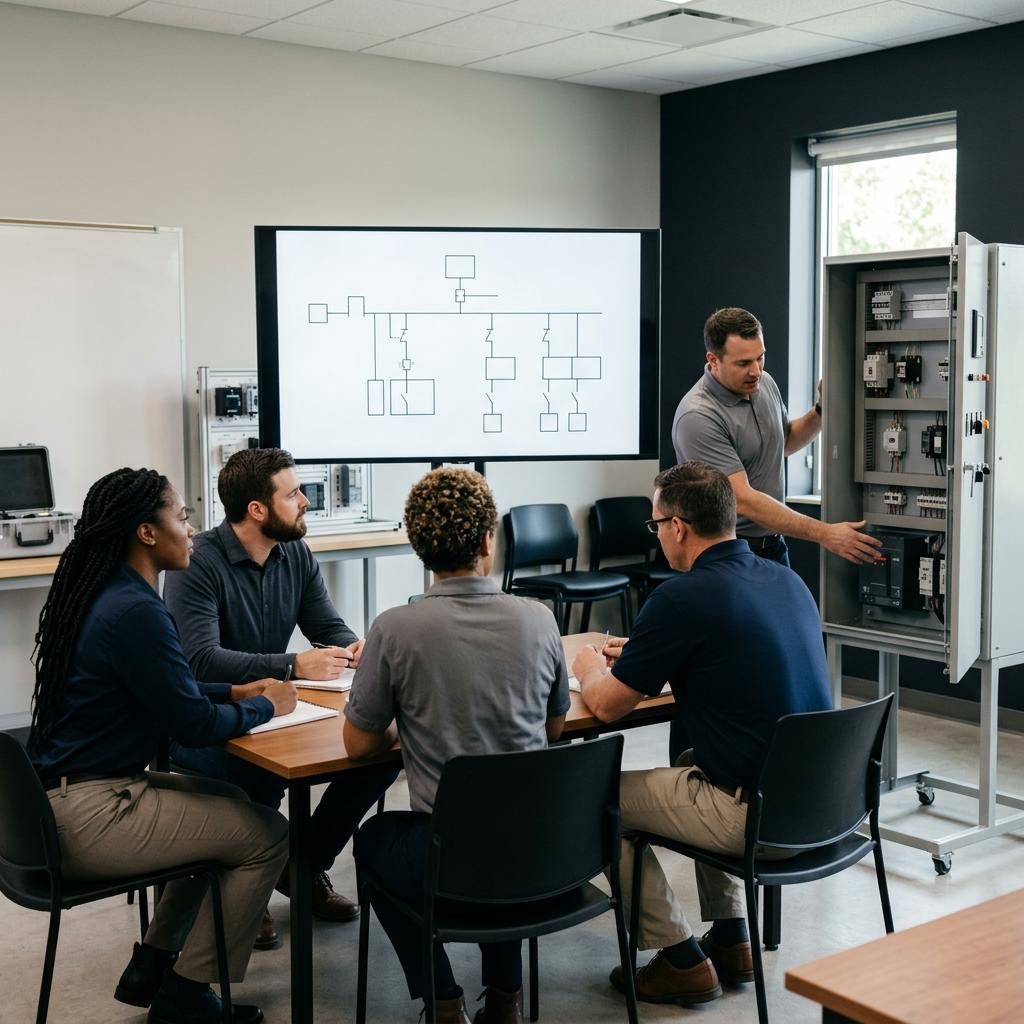
Instruction should reinforce how to interpret the information and when to stop for clarification. Our Wellington training service complements equipment-specific analysis by addressing electrical hazards and safe work practices for the people involved. It does not turn a worker into a qualified person for every task or replace appropriate supervision.
Plan the scope around your actual Wellington facility.
Wellington Multi-Building Assessment FAQs
Can an assessment include several buildings on one property?
Yes, the project can be scoped around the relevant electrical infrastructure across multiple buildings. Define the equipment, source relationships, and responsibility boundaries clearly. A single property address does not prove every asset shares the same supply or that one building's analysis can be reused for another.
Do motor control centers need separate attention from ordinary panels?
Their equipment characteristics, supplied loads, and upstream protection are relevant to the analysis. Avoid treating all distribution enclosures as equivalent. Describe the installed equipment when defining the scope, and ensure the documentation identifies the actual assets rather than assigning generic values based on appearance.
How do generators affect a Wellington facility's assessment?
Generator operation can create different current levels and protective-device responses from normal utility operation. Identify applicable transfer arrangements and permitted operating modes. The report should explain the configurations it covers so staff do not assume a result calculated for one supply condition applies to every alternative.
What if an electrical modification was never added to the drawings?
Flag the discrepancy during scoping and provide whatever project records remain available. The installed system may need verification and the study may require revision. Do not mark an uncertain circuit as verified or continue relying on an old label without resolving whether the changed conditions affect it.
Does the assessment replace our maintenance procedures?
No. It supplies hazard information and recommendations that can inform the safety program. Work still requires appropriate qualifications, planning, isolation and verification procedures, and protective measures. The employer and qualified personnel remain responsible for evaluating the actual activity and establishing the required safe conditions.
Contact Everything Arc Flash for Wellington Assessments
Contact Everything Arc Flash about the electrical infrastructure at your Wellington commercial, healthcare, educational, municipal, or institutional property. Share the number of buildings, the main equipment types, previous assessment information, and known modifications. We can discuss how to organize a scope that supports practical maintenance planning and clear equipment documentation.
Call 1-888-NFPA70E / 1-888-637-2703 or email info@everythingarcflash.com. If you manage additional properties outside Wellington, Areas We Serve links to the other existing city services without requiring you to search through individual navigation menus.