Arc Flash Risk Assessments in Palm Beach Gardens, FL
Arc flash risk assessments in Palm Beach Gardens, FL. Protect your facility with professional arc flash studies, electrical hazard analysis, and NFPA 70E support.

Property management companies, building engineers, and facility directors in Palm Beach Gardens need electrical safety information that can be used across maintenance planning, contractor coordination, and employee protection. Electrical infrastructure often serves multiple departments or tenants, making clear equipment documentation especially important.
Everything Arc Flash provides arc flash risk assessments in Palm Beach Gardens, FL, for commercial buildings, healthcare facilities, corporate campuses, institutional properties, and industrial operations. Arc flash studies and electrical hazard analysis help identify the conditions that should inform electrical work planning and NFPA 70E safety practices.
The assessment should connect technical findings to the people responsible for the building. Environmental health and safety managers need to understand the hazards and controls, while maintenance personnel need accurate equipment identification and accessible records. An effective project helps those groups work from the same information without suggesting that documentation alone removes electrical risk.
Electrical Safety Planning for Managed Properties
A managed property may have electrical records distributed among ownership, property management, maintenance contractors, and tenant representatives. Some buildings have undergone repeated renovations, while others contain equipment installed as part of a larger campus. Before analysis begins, identify who owns the records and who is responsible for keeping them current.
Palm Beach Gardens property teams should also identify operational restrictions. Access to electrical rooms, occupied spaces, essential systems, and tenant equipment may require coordination. Healthcare and institutional facilities can have additional planning considerations around continuity of operations. Those needs should be discussed during scoping, not discovered during an unplanned interruption.
- F01Commercial buildings and property management portfolios
- F02Healthcare facilities and corporate campuses
- F03Institutional properties and shared building services
- F04Industrial workplaces and facility maintenance departments
What an Arc Flash Study Contributes
- 01
An arc flash study uses electrical system information to evaluate potential thermal exposure under defined conditions. Depending on the agreed scope, the analysis may involve short-circuit information, protective-device operating characteristics, working distance, equipment configuration, and incident energy calculations. Results must be tied to the specific equipment and conditions represented.
- 02
The wider risk assessment considers the work performed and the protective measures needed. An arc flash boundary helps communicate a thermal exposure boundary; it does not replace shock approach boundaries or explain every hazard associated with equipment interaction. Facility procedures must address both the analysis and the practical circumstances of the task.
- 03
Our Arc Flash Risk Assessment services page explains how electrical studies support hazard identification and workplace planning. For a Palm Beach Gardens building, the next step is to define an equipment scope and establish which drawings and previous studies can be verified.
Build an Equipment Documentation Plan
Start with available one-line diagrams, equipment schedules, installation records, and existing arc flash labels. Confirm whether the documents reflect tenant fit-outs, service upgrades, generator installations, or protective-device changes. An old drawing can be a useful starting point, but it should not be assumed to represent the present system.
Field information may be needed to verify transformer details, conductors, protective devices, settings, and system connections. The project should identify unknown data and access restrictions. Any equipment opening or exposure to energized components must be managed under appropriate safety procedures by qualified personnel.
- D01Maintain equipment identifiers that match drawings and reports
- D02Record the analysis assumptions and operating configurations
- D03Keep labeling information connected to the final documentation
- D04Assign responsibility for recording future electrical modifications
A consistent documentation plan supports handovers between property managers and helps building engineers explain system conditions to qualified contractors. It can also reduce confusion when a maintenance task is planned months after the original assessment.

Use Findings to Support Employee Protection
Incident energy and boundary information can support job planning and protective equipment selection. It does not authorize energized work or replace the employer's responsibility to evaluate the task. Establishing an electrically safe work condition remains the priority where required, with suitable isolation, verification, and related procedures.
Employees need to understand what the labels mean, where the supporting report is kept, and whom to contact if equipment information is missing or inconsistent. Supervisors should not assume that possession of arc-rated clothing means every worker is qualified to perform electrical work. Responsibilities and training need to match actual job duties.
Arc Flash PPE Selection Guidance covers the relationship between assessment information and personal protective equipment. Protective measures should address thermal and shock hazards appropriately, and PPE remains part of a broader control strategy rather than the first or only response.
Connect the Assessment to Facility Maintenance
Study results depend on assumptions about electrical equipment and protective-device performance. Maintenance records, known defects, and equipment condition should therefore be part of the broader safety discussion. A report based on an expected device response is not a substitute for maintaining that device appropriately.
Building engineers can use assessment findings to identify documentation needs, review labeling, and plan further investigation. Proposed risk-reduction changes should be evaluated for their effect on the entire system, including protective-device coordination and operations. Do not make setting changes solely to reduce an incident energy number without appropriate technical review.
Our Arc Flash Safety-Related Electrical Maintenance Requirements page describes why maintenance and hazard evaluation belong together. For managed properties, the practical goal is a clear process linking electrical records, maintenance responsibilities, and work authorization.
Keep Campus and Building Assessments Current
Corporate campuses, healthcare properties, and multi-building facilities may change in stages. A service upgrade in one building, a new tenant load, or a revised standby arrangement may affect the information used for assessment. Establish a change-management process so electrical modifications prompt a review of the relevant study and labels.
NFPA 70E calls for updating the assessment when major modifications or renovations occur and reviewing it at intervals not exceeding five years. That review should verify that the information still represents the installation. Missing reports, unclear assumptions, or unreadable labels are reasons to investigate rather than simply renew a date.
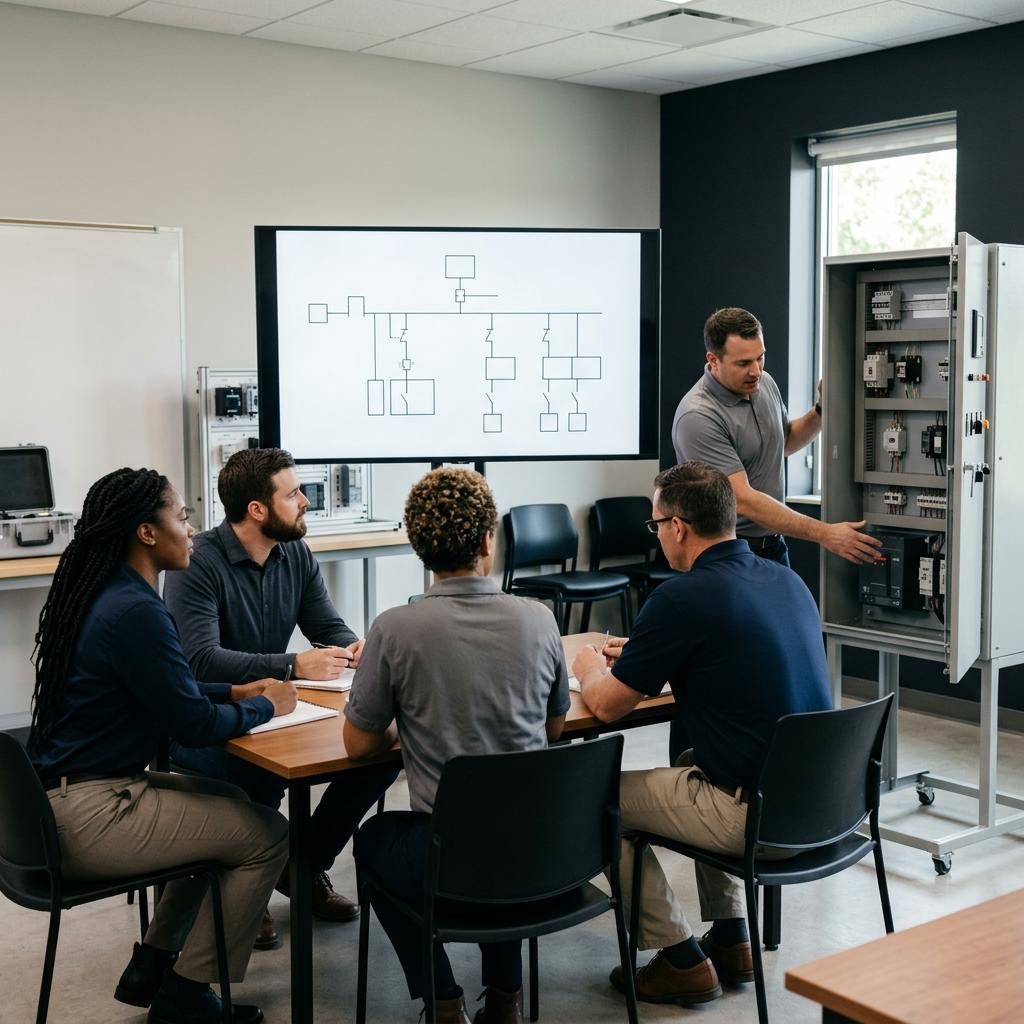
Personnel also need to understand how to apply updated findings. Our Palm Beach Gardens arc flash safety training page covers related instruction for employees and supervisors. Training and assessment serve different purposes, but planning them together can help translate technical information into safer workplace decisions.
Plan the scope around your actual Palm Beach Gardens facility.
Palm Beach Gardens Arc Flash Risk Assessment FAQs
Can an assessment cover several buildings on one campus?
A project can be scoped around multiple buildings, but the electrical relationships and equipment included must be defined. Shared services, alternate supplies, and separate distribution systems need to be understood. Provide available drawings and a building list so the scope reflects the actual campus arrangement.
Who should coordinate the assessment for a managed property?
A property manager, building engineer, facility director, or designated safety contact can coordinate records and access. The right contact should involve the people responsible for electrical maintenance and operating restrictions. Qualified personnel must handle electrical activities requiring their expertise.
Will equipment labels replace our electrical safety procedures?
No. Labels communicate selected hazard information, while procedures govern how work is evaluated and performed. Employees still need appropriate training, task planning, and protective measures. A label should be used with current documentation and the facility's electrical safety program.
How should a facility handle changes after the study?
Record electrical modifications and ask whether the analysis, drawings, or labels need updating. Changes to sources, transformers, conductors, equipment, or protective-device settings may affect the findings. Include assessment review in the change process instead of waiting until the next periodic review.
Does an arc flash assessment guarantee NFPA 70E compliance?
No. It supports the electrical safety program but cannot independently establish compliance. Work practices, qualified personnel, training, maintenance, documentation, and task-specific controls must also be addressed. The assessment provides information to support those responsibilities.
Contact Everything Arc Flash for Palm Beach Gardens Assessments
Contact Us about an arc flash risk assessment in Palm Beach Gardens, FL. Tell us about your commercial building, healthcare facility, corporate campus, institutional property, or industrial operation. Share your available drawings, previous reports, and maintenance planning needs so Everything Arc Flash can discuss an appropriate scope with your facility team.
Call 1-888-NFPA70E / 1-888-637-2703 or email info@everythingarcflash.com. For nearby facilities under the same management, see the dedicated Jupiter risk assessment page and discuss the locations involved when requesting assistance.