Arc Flash Risk Assessments in Boynton Beach, FL
Professional arc flash risk assessments in Boynton Beach, FL. Get arc flash studies, hazard analysis, equipment labeling, and NFPA 70E safety guidance.

A busy warehouse, manufacturing floor, or municipal workshop depends on electrical equipment that employees may rarely think about until maintenance is due. Knowing which panel supplies a machine is important; understanding the potential exposure when that equipment is approached or serviced requires a more deliberate evaluation.
Everything Arc Flash provides arc flash risk assessments in Boynton Beach, FL, for commercial, industrial, and institutional facilities. We help facility operators connect electrical system information with hazard analysis, equipment identification, and practical recommendations that support safer decisions about the work performed around their distribution systems.
The starting point is your actual facility, not a generic label package. Describe the buildings, equipment, work activities, and records available for review. Our Arc Flash Risk Assessment services can then be discussed in the context of your operations, access arrangements, and the electrical safety responsibilities shared by management and qualified workers.
Electrical Distribution Across Boynton Beach Workplaces
Electrical hazards can exist well beyond a main service entrance. Warehouses may distribute power to conveyors, battery-charging areas, ventilation, and loading equipment. Manufacturing facilities can have motor control centers and production machinery fed through several upstream devices. Commercial properties and institutional buildings may combine tenant panels, central mechanical equipment, and emergency systems.
For Boynton Beach municipal buildings and maintenance operations, responsibility may be divided among facilities staff, outside contractors, and individual departments. Agreeing on equipment names, study boundaries, and who maintains the records helps prevent gaps between those groups. An assessment should identify the equipment and operating conditions represented rather than imply that every electrical asset has been evaluated.
- F01Warehouse distribution supplying material-handling and support equipment
- F02Manufacturing power systems serving motors and production processes
- F03Commercial and institutional electrical rooms managed by facility teams
- F04Municipal workshops and maintenance buildings with varied electrical loads
From Equipment Records to an Informed Hazard Analysis
- 01
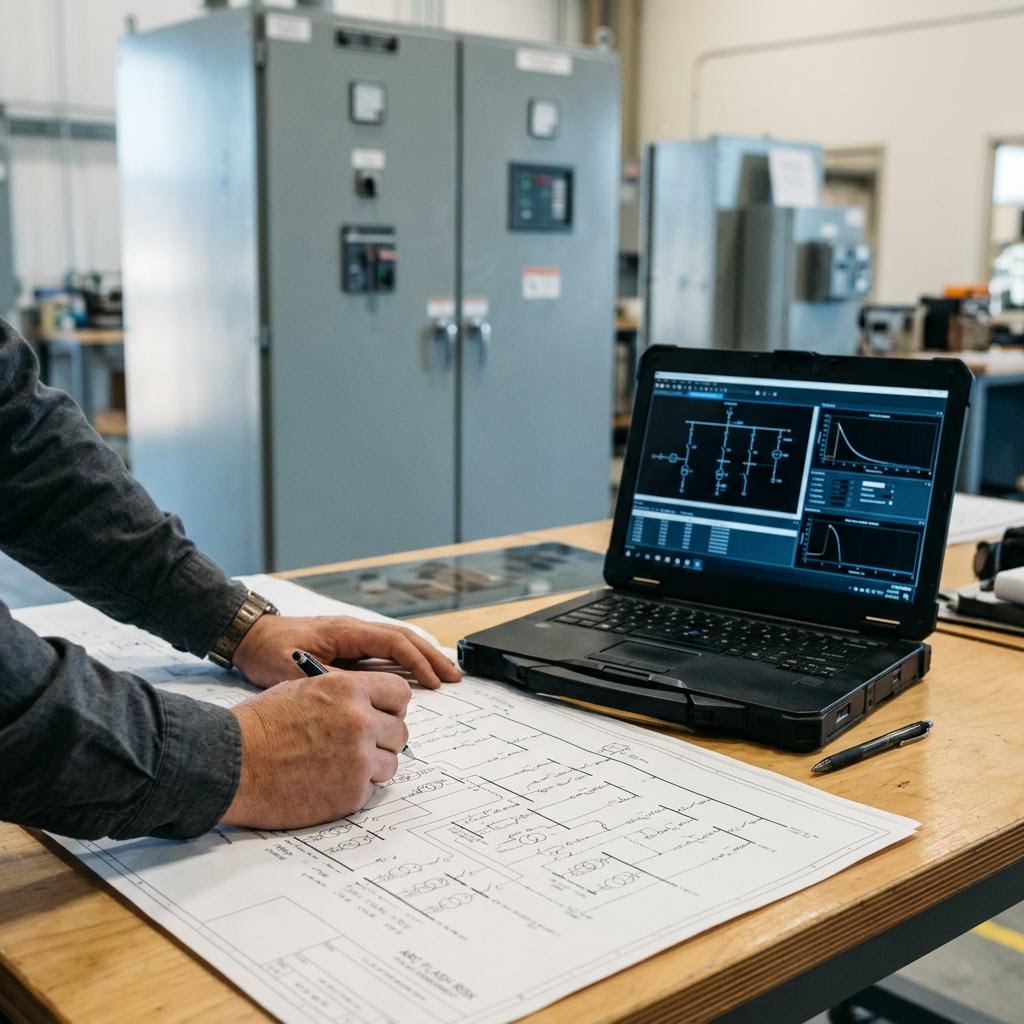
First, organize existing one-line diagrams, earlier studies, panel schedules, and records of additions or replacements. A drawing that predates a new production line or transformer may describe a different electrical system. Comparing available documentation with equipment identification helps establish what can be relied upon and what needs field verification.
- 02
Next, define how missing information will be obtained safely. Relevant inputs can include conductor characteristics, transformer information, protective-device types and settings, utility source data, and motor contribution. Personnel should not open energized equipment or collect information beyond their qualifications simply to prepare for a study. Access planning is part of the project discussion, not an instruction to expose live components.
- 03
Finally, document the configurations and assumptions used in the engineering evaluation. Normal utility operation and an alternate supply may produce different conditions. The Arc Flash Risk Assessment Process explains the broader sequence, helping your Boynton Beach team understand why the quality of field information affects the usefulness of the resulting calculations and recommendations.
Incident Energy, Boundaries, and Equipment Labels
An arc flash study evaluates the thermal exposure associated with an arcing fault under specified conditions. Incident energy is calculated at an identified working distance, using the applicable equipment and protective-device information. The result is not a general safety rating for every activity near that equipment; it belongs to the conditions, assumptions, and task distances represented in the analysis.
The arc flash boundary addresses a defined thermal exposure threshold. Electric shock remains a separate hazard requiring its own evaluation and protective measures. Workers need to understand both concepts rather than treating a single number on a label as permission to perform a particular task. Our Arc Flash PPE Selection Guidance provides related information about protective equipment decisions.
Labels should be associated with clearly identified equipment and supported by assessment records. During project scoping, establish which equipment requires labeling, what information the labels will convey, and how replacement labels will be controlled. A missing or unreadable label warrants attention, but applying a new sticker without checking its technical basis does not resolve uncertainty about the system.
Turn Study Findings into Workplace Risk Reduction
Useful recommendations distinguish between an immediate work-planning concern and a longer-term engineering or maintenance action. For example, a facility may need to clarify equipment identification, investigate a protective-device issue, or review the consequences of an operating configuration. Recommendations should explain their basis and identify matters requiring further evaluation instead of encouraging unreviewed changes.
Management should assign an owner and a reasonable follow-through process for each accepted action. Some changes may require outage planning, engineering design, contractor coordination, or additional analysis. Protective-device settings must not be adjusted casually to obtain a lower incident energy value; the effects on equipment protection and system coordination also matter.
The safest work approach is not established by calculations alone. De-energization, isolation, verification, access controls, and appropriate procedures remain central considerations for qualified personnel. An assessment supports the employer's electrical safety program, but neither a report nor a label guarantees compliance or eliminates the possibility of injury.
Maintain Documentation as Your Operations Change
A Boynton Beach warehouse may add conveyors, while a manufacturing operation replaces a motor or increases production capacity. A commercial property can add tenants, and a municipality can renovate a workshop. These changes should trigger a review of whether the existing study still represents the electrical distribution equipment and source conditions.
Keep a coordinated record of equipment names, drawing revisions, study assumptions, label information, and completed corrective actions. When a contractor changes a breaker or feeder, request the information needed by the person responsible for the assessment. Clear change records are more reliable than expecting a future survey to reconstruct years of undocumented work.
Maintenance condition also influences whether equipment can perform as intended. A calculated clearing time assumes relevant protective devices operate according to the conditions used in the study. Arc Flash Safety-Related Electrical Maintenance Requirements discusses this connection, which deserves attention alongside the analysis rather than being treated as a separate administrative issue.
Help Employees Use the Information Correctly
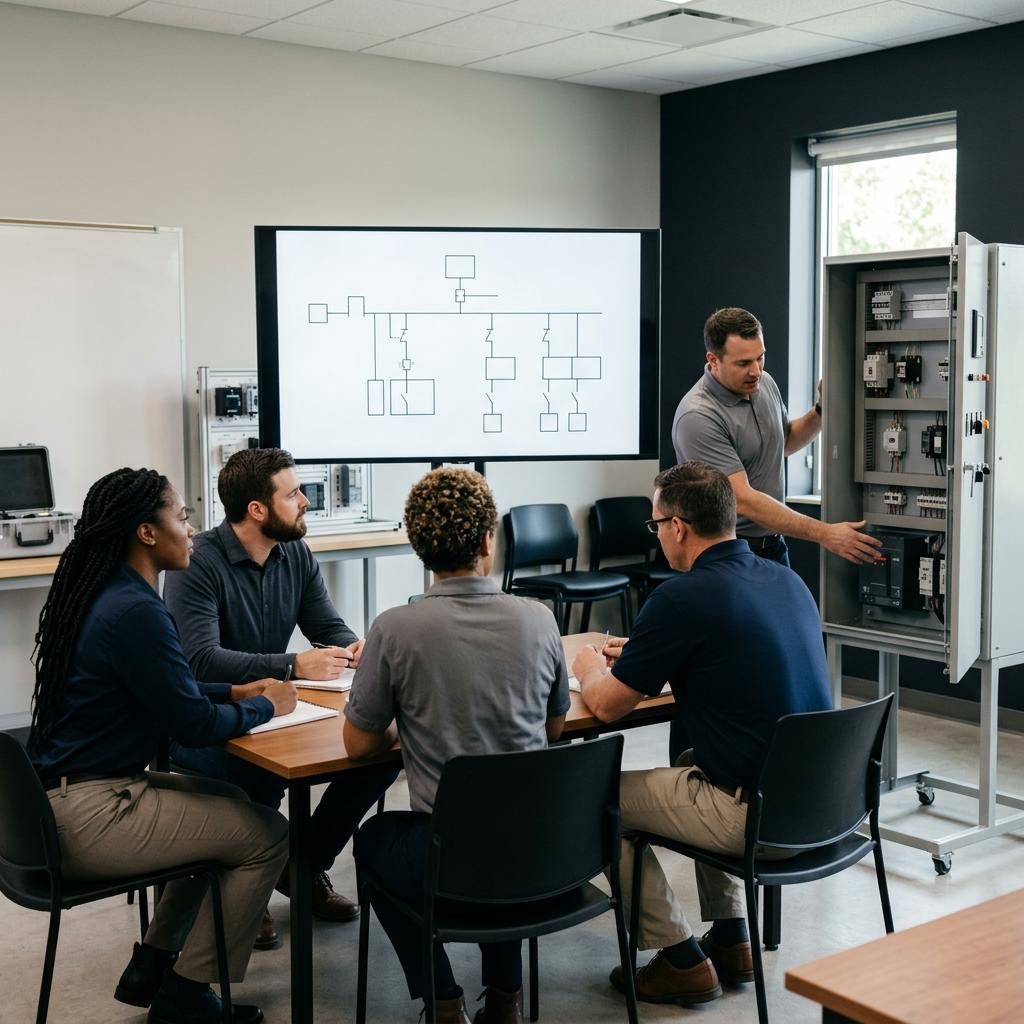
Supervisors need a practical way to introduce updated findings to the people affected by them. Explain where the report is stored, which equipment it covers, how changes are reported, and who resolves questions about labels. Qualified workers and contractors should receive the information relevant to their assigned tasks before work begins.
Training and hazard analysis serve different purposes. A study describes equipment-specific conditions, while employee instruction develops understanding of hazards, protective measures, and safe work practices. Our local training page outlines complementary support for Boynton Beach teams; completing a class does not replace the need for accurate system data or task-specific planning.
Plan the scope around your actual Boynton Beach facility.
Boynton Beach Arc Flash Assessment FAQs
Can one assessment cover a warehouse and its maintenance workshop?
It can be scoped to include both, provided the equipment and electrical relationships are clearly identified. Separate structures or departments do not automatically mean separate systems. Explain how each area is supplied and what personnel do there so the scope can address relevant distribution equipment without assuming coverage.
Should we replace old labels before requesting a study?
Document their condition and share any supporting report first. Existing labels may help identify previous work, but their values should not be assumed current. Discuss verification and replacement as part of the assessment rather than purchasing labels that may not correspond to today's equipment or settings.
What does incident energy tell our maintenance team?
It describes calculated thermal exposure at a specified distance for the modeled conditions. It helps inform protective measures, but does not account for every possible injury mechanism or authorize energized work. Employees still need procedures, appropriate qualifications, and an evaluation of the task and equipment condition.
Do institutional properties need to include contractors in planning?
Yes, contractor responsibilities and information exchange should be discussed before electrical work. Clarify who provides drawings, equipment identification, hazard information, and access authorization. An outside contractor's experience does not remove the need for the facility to communicate known conditions relevant to the work.
When should a Boynton Beach facility review its assessment?
Review it when electrical changes, new operating arrangements, or questions about existing information arise. NFPA 70E also calls for assessment review at intervals not exceeding five years and updates after major modifications or renovations. A material change should not be ignored until the periodic review date.
Contact Everything Arc Flash for Boynton Beach Assessments
Contact Everything Arc Flash to discuss your Boynton Beach facility and the electrical equipment involved. Bring available drawings, any previous study, the approximate number of buildings, and a description of known modifications. We can discuss assessment scope, documentation needs, equipment-labeling requirements, and how the project can be coordinated with your operations.
Call 1-888-NFPA70E / 1-888-637-2703 or email info@everythingarcflash.com. For properties extending beyond Boynton Beach, review Areas We Serve to find the existing service pages relevant to your other locations.